Automotive & Electric Vehicles × Critical Mineral Supply Collapse — March 2026
China Rare Earth Suspension & Red Sea JIT Disruption, March 2026
Executive Summary
The global automotive industry is navigating two simultaneous supply shocks that expose the structural fragility of just-in-time manufacturing at industrial scale. China's permanent magnet supply controls — maintained at 88% probability through 2026 — and the December 2025 extension of those controls to internationally-manufactured products have made Ford's EV production halt the opening event in what this report assesses as a recurring pattern, not a one-time shock. Simultaneously, Houthi attacks in the Red Sea have forced Cape of Good Hope rerouting, adding 10-14 days and 3,500 nautical miles to critical component logistics — a route disruption assessed at 65% probability of remaining the baseline through Q3 2026.
With China controlling 94% of permanent magnet manufacturing globally, 80% of battery-grade graphite processing, and 70% of battery-grade manganese processing, the automotive industry's EV transition is now running directly into a supply constraint that neither market forces nor policy responses can resolve within the EU's 2035 zero-emission mandate timeline at current pace. The sUI Score of 0.82 reflects a high strategic uncertainty environment where the gap between mandate ambition and supply reality is widening, not closing.
Top Key Findings
- Ford's EV production halt is not an isolated incident — it is the leading edge of a sector-wide contagion. With A1 at 88% (permanent magnet controls remain in force) and A3 at 72% (at least one additional top-10 OEM announces production halt in Q2 2026), the automotive industry is operating in a baseline-production-halt scenario, not a tail-risk scenario. Tier-2 and tier-3 suppliers will hit inventory floors before OEM procurement systems detect the signal.
- The December 2025 third-country control expansion means tier-1 suppliers in Germany, Japan, and South Korea manufacturing with Chinese-origin rare earths are now compliance-exposed without knowing it. The compliance liability falls on the OEM in most jurisdictions, not the tier-1 — creating an accountability gap that most legal teams have not yet identified.
Top Risk: Permanent magnet supply halts are the baseline scenario for 2026, not the tail risk — A1 at 88% combined with A3 at 72% means the probability of at least one additional major OEM production halt in Q2 2026 is a high-confidence forecast, and EV motors requiring 1-3 kg of rare earth magnets each have no near-term engineering substitute at scale.
SVI Score: 0.82 (HIGH) — The automotive sector is experiencing compound supply shock from simultaneous rare earth controls and Red Sea JIT disruption, with the EU 2035 mandate creating a structural timeline conflict that intensifies the urgency of near-term alternative sourcing decisions.
7 validated for robustness against alternative scenarios actions inside.
What you'll get inside
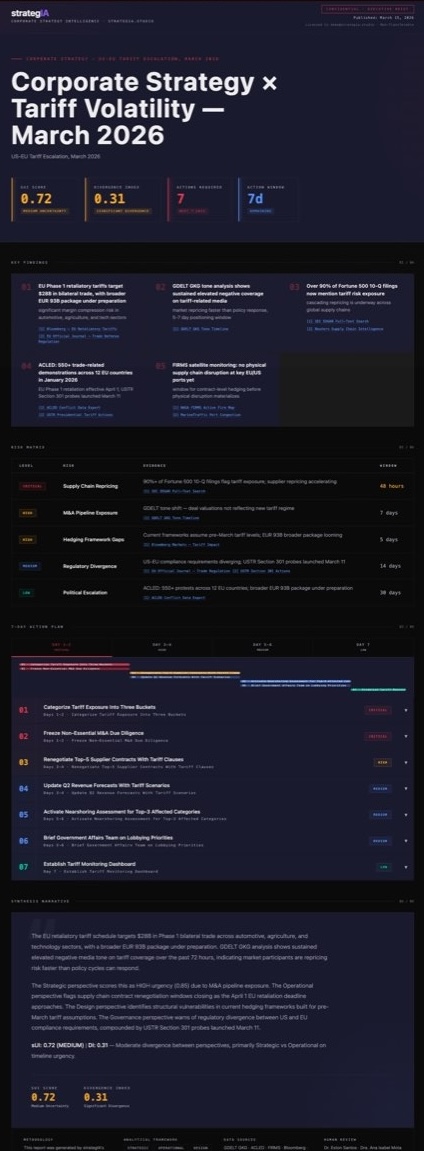
Full Report Preview
Get the Full Report
7 prioritized actions with full context, adversarial stress-test warnings, risk matrix, key findings, and downloadable watermarked PDF.
R$ 2.999,00 per report — less than 1 hour of consultant time.
One-time purchase · Instant access · Watermarked PDF included
Executive-grade analysis with the sUI methodology behind every score.
Buying multiple reports? Subscribe from R$ 11.999,00 for continuous sector coverage.
Powered by strategIA's agent ensemble.