sUI ALERTS
USAID program restoration will not exceed 25% of pre-March 2025 levels within the 12-month planning Sudan healthcare system will not functionally recover in 2026 without a ceasefire currently assessedConflict-adjacent markets (Egypt, Jordan, Lebanon, Kenya, Uganda) are absorbing 30–50% demand surgesGovernance Perspective: 0.82 urgency — "Does USAID contract termination create disclosure obligations and receivables liability requiring board-level review?"SPFS secondary sanctions exposure is the highest-ROI compliance action in the next 48 hours. A2 at 8Iran war OFAC designation expansion within 90 days (A3 at 75%) is a near-base-case outcome based on The December 2025 OFAC third-country intermediary guidance creates a behavioral compliance obligatioGovernance Perspective: 0.84 urgency — "Does SPFS secondary sanctions criminal liability require board-level authorization for the compliance program update?"The EU's 19th sanctions package (October 2025) structurally removed Russian LNG from European marketIran-Hormuz risk premium of $8–12/barrel is embedded in Brent crude pricing and will persist absent European LNG import terminal capacity — not supply availability — is the binding physical constraintGovernance Perspective: 0.89 urgency — "Does EU sanctions compliance for LNG transactions require board-level compliance program authorization?"More than half of all energy-transition minerals are now under some form of export control globally China's processing monopoly is both the primary supply risk and the primary compliance risk — A2 at DRC cobalt supply is a managed scarcity, not a market commodity — A1 at 85% reflects the structural Strategic Perspective: 0.87 urgency — "Is China's processing monopoly a permanent structural constraint or a temporary leverage instrument?"USAID program restoration will not exceed 25% of pre-March 2025 levels within the 12-month planning Sudan healthcare system will not functionally recover in 2026 without a ceasefire currently assessedConflict-adjacent markets (Egypt, Jordan, Lebanon, Kenya, Uganda) are absorbing 30–50% demand surgesGovernance Perspective: 0.82 urgency — "Does USAID contract termination create disclosure obligations and receivables liability requiring board-level review?"SPFS secondary sanctions exposure is the highest-ROI compliance action in the next 48 hours. A2 at 8Iran war OFAC designation expansion within 90 days (A3 at 75%) is a near-base-case outcome based on The December 2025 OFAC third-country intermediary guidance creates a behavioral compliance obligatioGovernance Perspective: 0.84 urgency — "Does SPFS secondary sanctions criminal liability require board-level authorization for the compliance program update?"The EU's 19th sanctions package (October 2025) structurally removed Russian LNG from European marketIran-Hormuz risk premium of $8–12/barrel is embedded in Brent crude pricing and will persist absent European LNG import terminal capacity — not supply availability — is the binding physical constraintGovernance Perspective: 0.89 urgency — "Does EU sanctions compliance for LNG transactions require board-level compliance program authorization?"More than half of all energy-transition minerals are now under some form of export control globally China's processing monopoly is both the primary supply risk and the primary compliance risk — A2 at DRC cobalt supply is a managed scarcity, not a market commodity — A1 at 85% reflects the structural Strategic Perspective: 0.87 urgency — "Is China's processing monopoly a permanent structural constraint or a temporary leverage instrument?"
strategIA
corporate strategyMarch 16, 2026

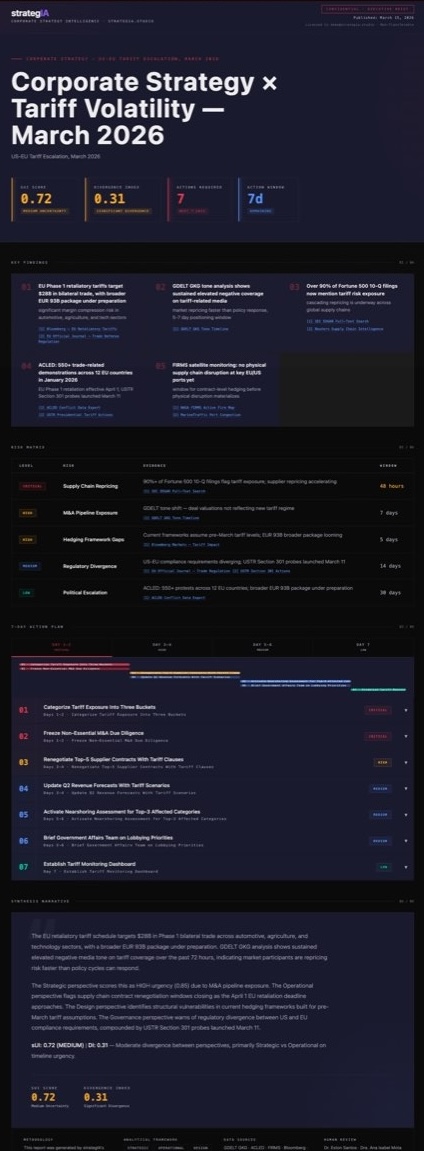
Corporate Strategy × Tariff Volatility — March 2026

US-EU-China Tariff Escalation & Yuan Oil Settlement Shift, March 2026

sUI — Uncertainty Index
0.74MEDIUM
Divergence
0.33

Executive Summary

The US-EU-China tariff escalation entered a critical phase in mid-March 2026. EU Phase 1 retaliatory tariffs ($28B) take effect April 1, with a broader EUR 93B package under preparation. Trump's 25% baseline "reciprocal tariffs" and auto-specific tariffs effective April 2 have pushed the US effective tariff rate to its highest level since 1909. Iran's announcement of oil sales in yuan (March 12) adds a dollar-hegemony dimension that corporate treasury functions are not yet pricing. Yale Budget Lab estimates $2,100–$3,800 in annual cost increases per US household.

sUI Score: 0.74 (HIGH) — Elevated uncertainty driven by conflicting signals: high-probability near-term pain (A1 at 85%, A3 at 90%) against low-probability de-escalation (A5 at 40%). Corporate strategy teams face asymmetric downside.

7 validated for robustness against alternative scenarios actions inside. Each action references the probability assumptions that govern its urgency.

7 Actions Inside

01Categorize Tariff Exposure Into Three Buckets
Why Now

A1 at 85% means EU Phase 1 tariffs take effect April 1, and A3 at 90% means suppliers are already repricing today — not waiting for April 1. Every day without a categorized exposure map is a day of blind renegotiation.

02Freeze Non-Essential M&A Due Diligence
03Renegotiate Top-5 Supplier Contracts With Tariff Clauses
04Model Three Revenue Scenarios Including Yuan Settlement Impact
05Activate Nearshoring Assessment for Top-3 Affected Categories
06Brief Government Affairs on Lobbying Priorities
07Establish Tariff + Currency Monitoring Dashboard

Full details — What, Why Now, and adversarial warnings — inside the report.

What you'll get inside

Full Report Preview

Get This Report — Free

7 prioritized actions with full context, adversarial stress-test warnings, risk matrix, key findings, and downloadable watermarked PDF.

Free for a limited time — regular price $49.

Enter your email to get instant access · Watermarked PDF included

4-perspective strategic assessment·OSINT data-driven analysis·Stress-tested by multi-agent intelligence·3 reports delivered

Buying multiple reports? Subscribe from $99/mo for continuous sector coverage.

See a sample report · Powered by strategIA's agent ensemble.