Critical Minerals & Mining × DRC Conflict and China Export Controls — March 2026
DRC Armed Conflict, China Export Weaponization & Energy Transition Demand Surge, March 2026
Executive Summary
The global critical minerals market has entered a managed scarcity regime that no market mechanism will resolve in the near term. The DRC, which holds over 70% of global cobalt reserves, imposed a cobalt export ban in February 2025, partially lifted in October 2025, and now operates under quota constraints directly linked to armed group activity in North and South Kivu. China — which controls 91% of rare earth separation, 80% of battery-grade graphite processing, and 70% of battery-grade manganese processing — escalated its export control framework in April 2025 and again in December 2025. More than half of all energy-transition minerals are now under some form of export control globally. The UN Security Council held an emergency briefing on "Energy, Critical Minerals, and Security" in March 2026. This is no longer a supply chain risk story. It is a geopolitical infrastructure story.
This report assesses six validated for robustness against alternative scenarios assumptions across DRC cobalt quota dynamics, Chinese processing monopoly weaponization, energy-transition demand trajectory, and alternative processing capacity development. The sUI Score of 0.83 reflects a high strategic uncertainty environment where the gap between energy-transition mineral demand and non-Chinese supply capacity is assessed at 78% probability of exceeding ex-China capacity by 2027. The February 2026 US Critical Minerals Ministerial signed 11 bilateral frameworks — a genuine policy response. But processing capacity takes 3-5 years to build. The decision that matters right now is not about policy. It is about strategic reserves, dependency mapping, and processing alternatives.
Top Key Findings
- Over half of energy-transition minerals are now under some form of export control globally — and A4 at 70% assesses that at least one additional major mineral category (beyond rare earths) will be subject to Chinese export controls within 12 months. Graphite (80% of battery-grade supply from China) and antimony are the leading candidates. If graphite controls materialize simultaneously with rare earth controls, the EV and energy storage industries face compound input constraints that cannot be resolved by alternative sourcing within 24 months.
- Global demand for energy-transition minerals will exceed ex-China supply capacity by 2027 regardless of policy interventions (A3 at 78%). This is not a policy gap — it is a physical capacity gap. Non-Chinese processing facilities that do not exist today cannot be built and qualified before 2027. The only near-term hedge is strategic reserve building from non-Chinese sources at current pricing, before demand pressure further tightens the non-Chinese spot market.
Top Risk: China's processing monopoly (A2 at 90%) combined with the high probability of expansion to graphite and antimony (A4 at 70%) creates a scenario where two simultaneous supply constraints — on both EV motors (rare earths) and EV batteries (graphite) — materialize within the same 12-month window, producing a compound supply shock for which no near-term alternative exists at scale.
SVI Score: 0.83 (HIGH) — The critical minerals sector is operating at the intersection of armed conflict (DRC), geopolitical weaponization (China), and energy-transition demand surge — a triple-driver environment that makes strategic reserve building and processing diversification the highest-return risk management investments available in 2026.
7 validated for robustness against alternative scenarios actions inside.
What you'll get inside
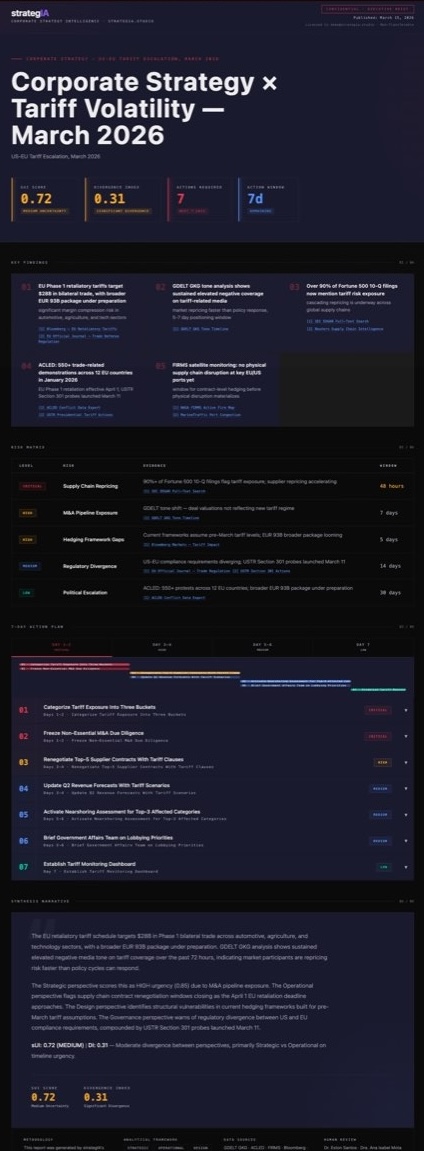
Full Report Preview
Get the Full Report
7 prioritized actions with full context, adversarial stress-test warnings, risk matrix, key findings, and downloadable watermarked PDF.
R$ 2.999,00 per report — less than 1 hour of consultant time.
One-time purchase · Instant access · Watermarked PDF included
Executive-grade analysis with the sUI methodology behind every score.
Buying multiple reports? Subscribe from R$ 11.999,00 for continuous sector coverage.
Powered by strategIA's agent ensemble.