Defense & Security × NATO Wartime Procurement — March 2026
NATO Wartime Procurement Urgency — Iran War, Hormuz Closure & European Defense Surge, March 2026
Executive Summary
The February 28, 2026 US-Israel strikes on Iran have fundamentally shifted NATO procurement from peacetime compliance planning to wartime urgency. European allies have pledged a €200B defense spending surge (Breaking Defense: Europe now accounts for 2.1% of global defense spending, led by Berlin). The Strait of Hormuz is effectively closed — marine insurance cancelled, Maersk suspended — severing supply chains for defense electronics and rare earth minerals. NATO ammunition stockpiles are already depleted from 3+ years of Ukraine support, and production facilities across NATO nations are operating at capacity. Trump has asked NATO allies to send vessels to Hormuz for coalition patrols.
sUI Score: 0.69 (MEDIUM-HIGH) — Unusually low divergence (DI: 0.28) reflects high agreement on severity; primary uncertainty is execution tempo against wartime demand pace.
7 validated for robustness against alternative scenarios actions inside. Each action references the probability assumptions that govern its urgency.
What you'll get inside
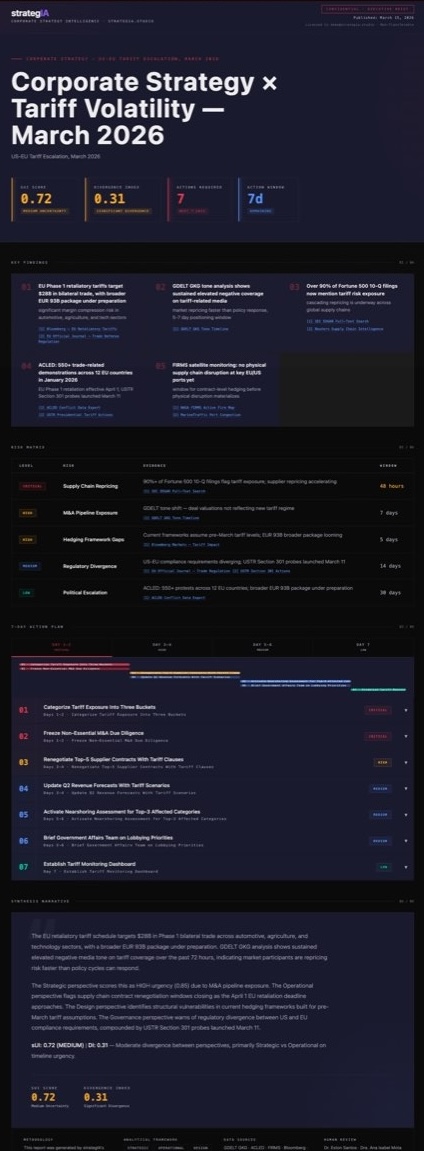
Full Report Preview
Get the Full Report
7 prioritized actions with full context, adversarial stress-test warnings, risk matrix, key findings, and downloadable watermarked PDF.
R$ 2.999,00 per report — less than 1 hour of consultant time.
One-time purchase · Instant access · Watermarked PDF included
Executive-grade analysis with the sUI methodology behind every score.
Buying multiple reports? Subscribe from R$ 11.999,00 for continuous sector coverage.
Powered by strategIA's agent ensemble.