Financial Services & Sanctions Compliance × Russia-Ukraine and Iran War Fragmentation — March 2026
Russia-Ukraine Sanctions Escalation & Iran War SWIFT Fragmentation, March 2026
Executive Summary
The EU's 19th sanctions package (October 2025) materially escalated the compliance environment for global financial institutions, requiring re-screening of all correspondent banking relationships against expanded Russian designations. Simultaneously, Russia's SPFS (SWIFT alternative) is growing in non-Western economies, and the US has warned foreign banks that SPFS participation carries secondary sanctions risk — creating a detection problem for financial institutions with indirect SPFS exposure through their correspondent networks. The December 2025 OFAC guidance on sanctions evasion via third-country intermediaries added a behavioral compliance dimension that standard list-matching screening systems were not designed to address.
The Iran-Israel war of June 2025 accelerated this fragmentation dynamic: new OFAC designations have expanded the Iranian sanctions perimeter, AI-enabled cyberattacks on SWIFT messaging infrastructure are escalating in 2026, and the financial system is bifurcating into Western bloc (SWIFT) and alternative system bloc (CIPS/SPFS) payment rails in ways that create both compliance and operational continuity risks. The sUI Score of 0.77 reflects a high strategic uncertainty environment where six simultaneous compliance and operational risk vectors are compressing the response window for financial institutions.
Top Key Findings
- SPFS secondary sanctions exposure is the highest-ROI compliance action in the next 48 hours. A2 at 80% probability means the US is actively monitoring SPFS usage and has signaled secondary sanctions against enabling institutions. If any of your correspondent banks have SPFS-related transactions, you carry indirect secondary sanctions exposure that your current due diligence frameworks were not designed to detect — and that regulatory examiners will identify before you do.
- Iran war OFAC designation expansion (A3 at 75%) means new designation categories will emerge within 90 days. Sanctions screening systems built on current SDN lists are already behind the threat curve. Emergency re-screening is required now, and the December 2025 OFAC third-country intermediary guidance creates a behavioral compliance layer that list-matching alone cannot satisfy.
Top Risk: SPFS secondary sanctions exposure combined with Iran-linked OFAC designation expansion creates a dual compliance threat — both from what your correspondents are doing (A2 at 80%) and from what your screening systems are not catching (A3 at 75%) — operating simultaneously in the same 90-day window.
SVI Score: 0.77 (HIGH) — The financial services sector is navigating the most volatile sanctions compliance environment since the 2012–2015 Iran sanctions cycle, with six simultaneous risk vectors and a regulatory enforcement posture that has shifted from guidance to active investigation in Q2 2026.
7 validated for robustness against alternative scenarios actions inside.
What you'll get inside
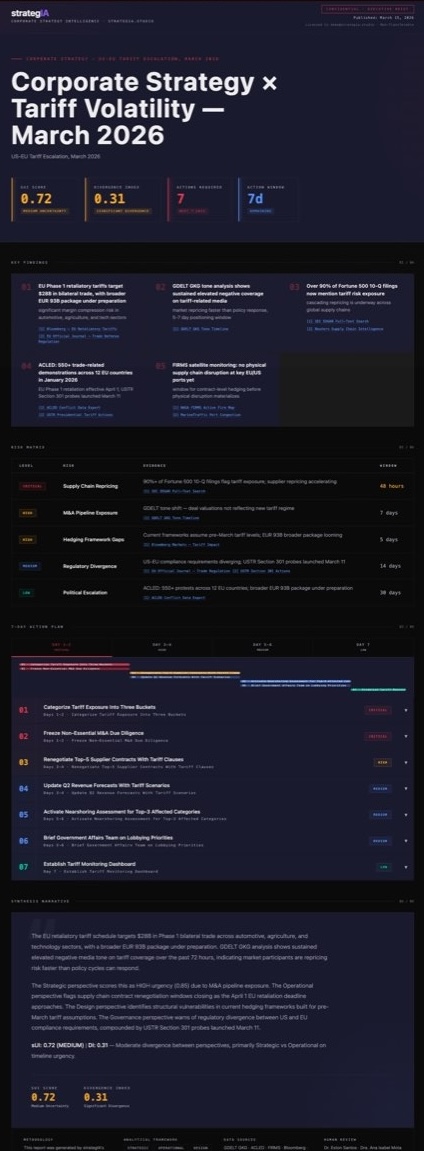
Full Report Preview
Get the Full Report
7 prioritized actions with full context, adversarial stress-test warnings, risk matrix, key findings, and downloadable watermarked PDF.
R$ 2.999,00 per report — less than 1 hour of consultant time.
One-time purchase · Instant access · Watermarked PDF included
Executive-grade analysis with the sUI methodology behind every score.
Buying multiple reports? Subscribe from R$ 11.999,00 for continuous sector coverage.
Powered by strategIA's agent ensemble.